
Asset tags
built for
the field.
Laser-bleached white-on-black marks on Tesa 6973 and 3M 7847 acrylate film — tamper-evident, UV-stable, and chemical-resistant to +392°F. Permanent identification for hardware that can’t take a direct laser mark, in environments where a printed label won’t last the season.
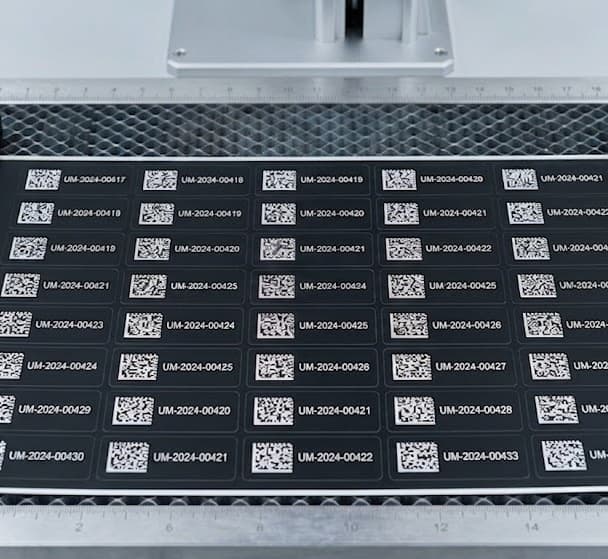
Tesa 6973 and 3M 7847: the labels that replace the plate.
Tesa 6973 and 3M 7847 are dual-layer acrylate films engineered as substitutes for etched metal nameplates: a black top layer over white, brittle by design. The construction is the entire point — it is what makes the mark permanent, the bond reliable, and the removal visible.
- Thermal rangeBoth stocks are rated to +392°F; Tesa 6973 is rated down to −58°F. Survives sterilization cycles, exterior winters, and engine-bay heat soaks.
- Chemical resistanceHolds up to common solvents, cleaning agents, fuels, and oils encountered in industrial maintenance.
- UV stabilityDesigned for sustained outdoor exposure without color drift, embrittlement, or adhesive failure.
- Abrasion resistanceAcrylate surface takes routine handling and impact contact that would destroy a printed label.
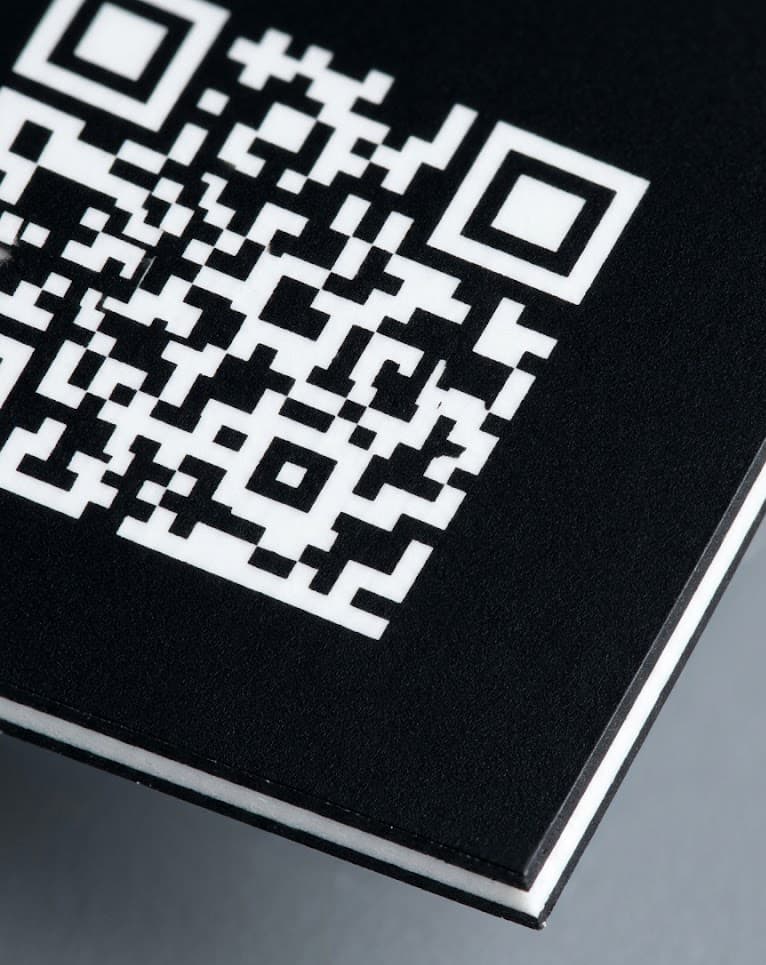
MOPA bleach. White-on-black, in-substrate.
The same utah marking JPT M7 MOPA fiber laser that produces MIL-STD-130 Data Matrix on stainless drives the asset-tag process. Pulse parameters are tuned to ablate only the black top layer — uncovering the bright white sub-layer and producing a high-contrast graphic in the material itself.
Because the mark is a structural change, not a deposit, there is nothing to scratch off, dull, or wash away. The QR or Data Matrix code on a tag installed today reads the same after years of UV, solvent, and physical contact.
The same stock and process produce MIL-STD-130 UID labels with the UII encoded in ISO/IEC 15434 Format 06 or Format 12.
Code density and module size are dialed per part. We verify every code at 100% before shipment — failures don’t leave the facility.
For assets in marine, chemical, or decades-long outdoor service, where even an acrylate film is the weak point, the same codes go on laser-annealed stainless asset tags. For valve tags, legend plates, and panel tags in short runs, see metal tags.
If it’s been moved,
you’ll see it.
Both films are engineered to fragment under removal force. A tag cannot be peeled cleanly from one device and re-applied to another — the substrate breaks apart and the original placement leaves visible residue. For asset management programs that need a chain-of-custody signal, this is the difference between an audit trail and a guess.
- Sticker swap defeatAn adhesive-only label can be lifted and moved silently. A destructible acrylate tag cannot.
- Audit visibilityRemoval attempts leave a fragmented footprint that survives the inspection cycle.
- Pairs with databaseEach QR scan logs to your asset record. A missing or fragmented tag flags the asset for review.
Built for the assets a metal stamp can’t reach.
Direct laser marking remains our preferred approach for parts that accept it. Asset tags fill the gap when the substrate, finish, or geometry rules direct marking out.
- 01
Security & access control
Cameras, sensors, and card readers spread across a property. Each endpoint gets a permanent, scannable link to the asset database — and a visible signal if anyone tries to swap or remove it.
- 02
Facilities & IT/OT infrastructure
Network closets, switchgear, HVAC equipment, instrumentation. Tags survive cleaning chemicals and routine maintenance contact without abrading or peeling.
- 03
Outdoor & UV-exposed hardware
High-altitude, high-UV environments where printed labels and standard adhesive stickers fade or curl within a season. The mark is in the substrate, not on top of it.
- 04
Lab equipment & calibration assets
Permanent IDs for instruments that move between benches and clean cycles. Compatible with isopropyl alcohol, acetone, and standard lab solvents.
- 05
Fleet, tooling & ground support
Asset tags on equipment that lives outdoors, gets handled, and accumulates wear. The double-layer construction takes abrasion that would destroy a printed label.
- 06
Hardware that can’t take a direct mark
Plastic enclosures, painted surfaces, anodized housings where direct laser marking would damage finish or void warranty. The tag carries the ID instead of the part.
What does “tamper-evident” mean in practice?
Both Tesa 6973 and 3M 7847 are brittle, dual-layer acrylate films engineered to fragment when peeled. A tag removed from one device cannot be re-applied to another without visible damage, producing a permanent visual indicator of unauthorized handling.
How is the mark applied — and why won’t it wear off?
We use MOPA fiber laser bleaching to convert the black top layer to a high-contrast white where the beam passes. The mark is a phase change inside the substrate, not ink or toner on top of it, so it is not affected by abrasion, UV exposure, or cleaning chemicals.
How durable are the tags in the field?
Both stocks are rated to +392°F, and Tesa 6973 is rated down to −58°F. Both are UV-stable, abrasion-resistant, and chemical-resistant: 3M reports no change to 3M 7847 after 2,000 hours of xenon weathering, 150 hours of salt spray, and diesel and brake-fluid immersion, and tesa reports no change to 6973 after 2,000 hours of weathering. The acrylate construction is designed to replace etched metal plates in service.
Tesa 6973 or 3M 7847 — which should I specify?
Both are tamper-evident, laser-markable acrylates that take the same white-on-black mark, so either works for most assets. 3M 7847 uses 3M 350 adhesive, which bonds well to low-surface-energy plastics, powder coat, oily metals, and textured surfaces, and it is a UL and CSA recognized component. Tesa 6973 has the wider published temperature range and also comes in white and silver faces with black text. Tell us the surface and environment and we will recommend one.
Can you handle variable data and serialization across many unique tags?
Yes. CSV-driven variable data — sequential serial numbers, unique QR or 2D Data Matrix payloads, asset IDs — with 100% verification before shipment. The output matches your inventory database asset-for-asset.
What sizes and shapes are available?
Tags are kiss-cut from sheet stock to your spec. Common formats range from 0.5" QR tiles for small endpoints to 2"+ rectangular plates for cabinets and equipment. Send dimensions and we will quote material yield.
Why use a tag instead of marking the part directly?
Direct laser marking is the right answer when the substrate accepts it. For plastic enclosures, painted surfaces, anodized finishes, or any hardware where direct marking would damage the part or void a warranty, a tamper-evident tag carries the identification without touching the asset itself.
Send your asset list — we’ll quote the run.
Variable data, kiss-cut sheets, and 100% verified codes — turned around from Ogden, inside the lead times of out-of-state industrial label suppliers.