Skip to content
Utah Marking — Industrial Marking & Traceability
EQPEQUIPMENT & COMPLIANCE PLATES

Stainless equipment
& compliance plates,
built for harsh environments.

Laser-annealed 316L stainless nameplates, rating plates, and asset tags for equipment that lives outdoors, at sea, in washdown, or in an engine bay: OSHA and NEC rating plates, USCG and SOLAS marine plates, EPA emission labels in metal, and serialized stainless asset tags. Marked to your drawing or the applicable rule, proofed before the cut, shipped anywhere in the U.S.

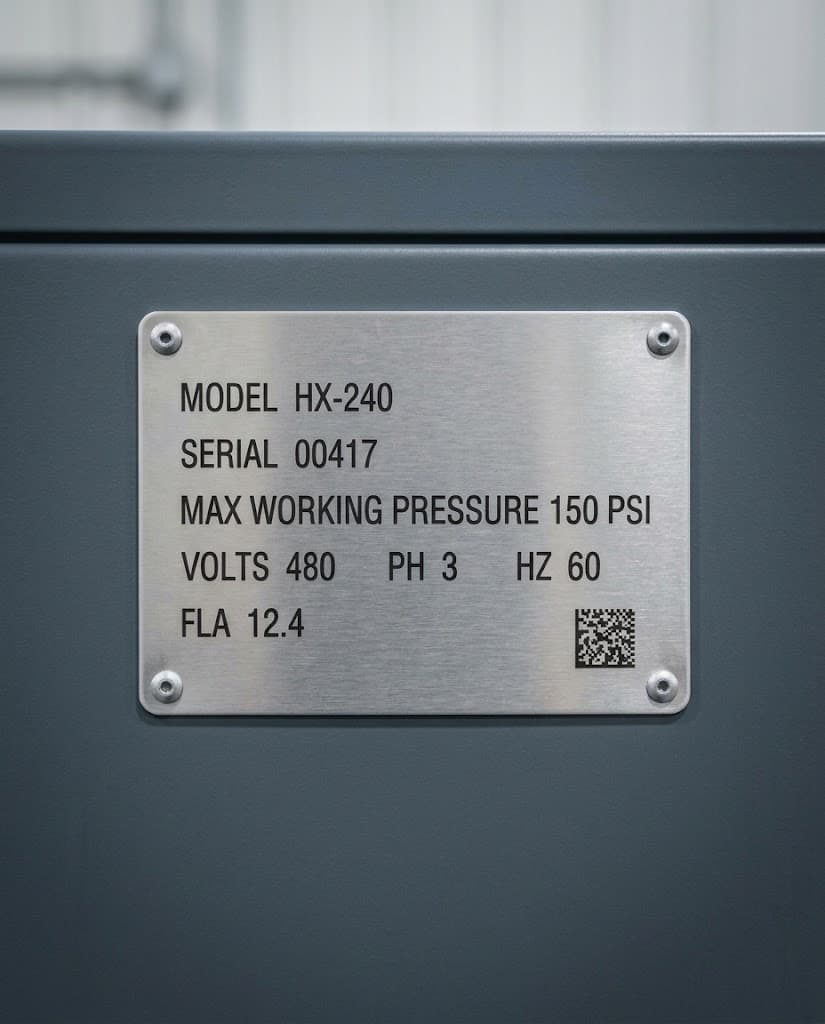
Brushed 316L stainless equipment nameplate riveted at four corners to a gray powder-coated steel housing, laser-marked MODEL HX-240, SERIAL 00417, MAX WORKING PRESSURE 150 PSI, VOLTS 480 PH 3 HZ 60, FLA 12.4, with a small Data Matrix code at lower right.
Substrate
316 / 316L stainless
Mark process
MOPA fiber laser anneal
Service environment
Marine · outdoor UV · washdown · chemical
Mounting
Adhesive · rivets · fasteners · weld
Variable data
Serials, QR, Data Matrix from CSV
Run size
Single plate to production lot
01THE ENVIRONMENT

The plate has to outlast the paint around it.

Most compliance and identification plates fail the same way: the equipment is still in service and the plate is not readable. Printed labels chalk and lift. Anodized aluminum fades in UV and pits in salt. Filled engraving loses its fill. The rule that required the plate usually also requires it to stay legible, so an unreadable plate is a finding, not a cosmetic problem.

316L stainless, laser-annealed, is the durable answer. Annealing grows a black oxide inside the steel rather than cutting into it or printing on it, so there is no coating to fail and the passive layer that gives 316L its corrosion resistance stays continuous across the mark. The plate reads the same after years of salt spray, washdown, fuel, and sun. The process is the one we run for ASME and NBIC code nameplates; see marking stainless steel for the metallurgy.

Mounting matters as much as material. Adhesive backing suits flat housings; rivets or tamper-resistant fasteners where the rule asks that removal be evident; bare plates for welding to a frame. We supply whichever the installation calls for.

02PLATE FAMILIES

Four kinds of plate, one process.

The regulation sets what the plate says and how it attaches. The content, the approval, and the compliance determination are yours; the plate is ours.

FAMILY 01

OSHA, NEC & NFPA equipment plates

Rating and identification plates the equipment is required to carry, legible for its working life.

Rated-load plates for cranes and hoists, identification tags for slings and rigging hardware, machinery electrical nameplates, and the manufacturer identification the NEC calls for on electrical equipment. OSHA’s crane rule asks for the rated load marked on each side of the crane, its sling rule for a durable, permanently affixed identification showing size, grade, rated capacity, and reach, and NEC 110.21 for manufacturer markings and field-applied hazard markings durable enough for the environment they sit in. The content comes from your engineering and the applicable rule; we produce the plate to it.

  • Crane and hoist rated-load plates (29 CFR 1910.179, ASME B30)
  • Sling and rigging identification tags (29 CFR 1910.184)
  • Machinery electrical nameplates (NFPA 79, NEC 110.21)
  • Pressure, temperature, and capacity rating plates
  • Manufacturer identification and serial plates
FAMILY 02

USCG & SOLAS marine plates

Plates that have to survive salt spray, UV, and fuel on a hull or a piece of lifesaving equipment.

Capacity plates for recreational boats under 33 CFR 183, hull identification number plates under 33 CFR 181, builder’s plates, and the identification and approval plates carried by USCG-approved and SOLAS equipment. The capacities, the HIN, and the approval numbers are determined by the builder or the equipment manufacturer under their own approval; what we add is a plate that stays legible in a marine environment and attaches so that removal or alteration is evident.

  • Capacity plates — persons, weight, horsepower (33 CFR 183 Subpart B)
  • Hull identification number plates (33 CFR 181)
  • Builder’s and manufacturer plates
  • USCG approval and SOLAS / MED equipment identification plates
  • Lifesaving, fire, and navigation equipment labels in metal
FAMILY 03

EPA & environmental compliance plates

Permanent labels where the regulation says permanent and the engine bay says hot and oily.

Engine emission control information labels under 40 CFR 1068.45 must stay legible for the life of the engine and be affixed so they cannot be removed without being destroyed; a riveted stainless plate meets that standard where a printed label will not. The same applies to fuel and chemical storage tank data plates, generator set nameplates, and refrigerant and process equipment labels in outdoor or washdown service. Artwork and content come from your approved label design; we reproduce it in metal.

  • Engine emission control information labels (40 CFR 1068.45)
  • Fuel and chemical storage tank data plates
  • Generator set and compressor nameplates
  • Refrigerant and HVAC-R equipment labels
  • Process equipment identification in corrosive service
FAMILY 04

Stainless asset tags

For assets where an acrylate tag is not enough: sun, salt, solvents, or decades of service.

Serialized stainless tags with a QR code or Data Matrix, asset number, and owner identification, driven from your asset register. Every code is read back against its source row before shipment. For indoor and most outdoor facilities hardware, our tamper-evident acrylate asset tags are lighter and lower cost; stainless is the answer for marine, chemical plant, utility, and field equipment that outlives any label.

  • QR or Data Matrix plus human-readable asset number
  • Owner name, logo, and contact in the same mark
  • Serial ranges or CSV-driven lists
  • Adhesive-backed, drilled, or wire-tie slots
  • Round, rectangular, and custom outlines

For hardware that does not need metal, the tamper-evident acrylate asset tags are lighter and lower cost. For pressure equipment nameplates, see ASME & NBIC code nameplates.

03WHAT TO SEND

Send the drawing or the rule. A proof comes back first.

Nothing is cut until you have approved a layout proof with the actual character heights called out. Variable data runs from a CSV, and every plate is checked against its source row before it ships.

  1. 01 · The drawing or the rule
    Your plate drawing, or the regulation or standard figure the plate has to satisfy. Where neither exists yet, a sketch and the list of required fields is enough to start a proof.
  2. 02 · Fixed strings
    Company name, model, ratings, approval numbers, and any legally required wording, exactly as they must appear. We mark what you send and proof it back to you first.
  3. 03 · Variable data
    Serial numbers, capacities, dates, or asset IDs as a CSV, one row per plate. Or tell us which fields stay as ruled blanks for completion at installation.
  4. 04 · Size, gauge, and mounting
    Finished dimensions and corner radius; adhesive, rivet or screw holes, or bare for welding. Describe the surface it attaches to and we will recommend a gauge.
  5. 05 · Service environment
    Marine, outdoor, washdown, chemical, or engine-bay exposure. It drives alloy and mounting recommendations.
  6. 06 · Quantity and need date
    One replacement plate or a production run. Plates are cut from sheet in-house, so small lots are not a problem.
04FREQUENTLY ASKED

Equipment and compliance plate questions.

Why stainless instead of anodized aluminum or printed polyester?

Service life. Anodized aluminum pits in salt spray and its dye fades under UV; printed and overlaminated polyester labels lift, chalk, and lose contrast long before marine, outdoor, or washdown equipment leaves service. A laser-annealed mark on 316L stainless is a black oxide grown in the steel itself, with no ink, fill, or coating to fail, and because no metal is removed the plate keeps its full corrosion resistance across the mark. Where the plate lives indoors in a benign environment, aluminum or a printed label may be the economical choice, and we will say so.

Can you make USCG capacity plates and HIN plates?

Yes. The maximum persons, weight, and horsepower on a capacity plate are determined by the boat builder under 33 CFR 183, and the hull identification number is assigned by the manufacturer under 33 CFR 181; we produce plates carrying the values you supply, laid out to the display requirements in the rule or to your drawing. HIN plates are made to attach so that removal or alteration is evident. We are a plate manufacturer, not a certifying body, so the figures and the compliance determination remain yours.

Can a compliance plate carry a QR code or Data Matrix?

Yes. A 2D code linking to the equipment record, inspection history, or manual sits alongside the required text, and serialized codes are driven from your CSV so each plate is unique. Every code is scanned before shipment and the decoded data checked against its source row. Let us know on the RFQ if your specification calls for graded barcode verification.

Can you produce red, yellow, or color-coded safety plates?

Laser annealing produces a dark mark on bare stainless, so plates are black-on-silver. Where a regulation or ANSI Z535 requires signal colors, such as DANGER or WARNING headers, a printed or color-filled sign is usually the right product, and we will tell you if what you are asking for is better made another way. Black-on-stainless suits rating plates, identification plates, and informational markings where permanence matters more than color.

How are plates attached?

Your choice: high-performance acrylic adhesive backing for flat or gently curved surfaces, holes for screws or drive rivets where the rule asks for mechanical fastening or tamper evidence, or bare plates for welding. Attachment happens at your shop or in the field. Tell us the surface, its curvature, and the environment and we will recommend the gauge and method.

Do you certify that the plate meets the regulation?

No. Compliance with OSHA, NEC, USCG, SOLAS, or EPA requirements is determined by the equipment manufacturer, builder, or owner, often under an approval or listing in their name. We produce the plate to your drawing or the applicable figure, proof it before cutting, and supply a Certificate of Conformance covering material and marking on request.

Is there a minimum quantity?

No minimum. A single replacement plate for a crane that has lost its rating plate, or a few HIN plates for a short production run, is routine alongside production lots. Setup, not quantity, is the cost driver.

STAINLESS PLATES, SHIPPED ANYWHERE

Send the drawing. We’ll return a proof, then the plates.

316L stainless, laser-annealed, adhesive-backed, drilled, or bare for welding. One replacement plate or a production run; quotes within one business day.