Skip to content
Utah Marking — Industrial Marking & Traceability
IUIDMIL-STD-130 MARKING SERVICES

MIL-STD-130
marking services,
on the part or on a label.

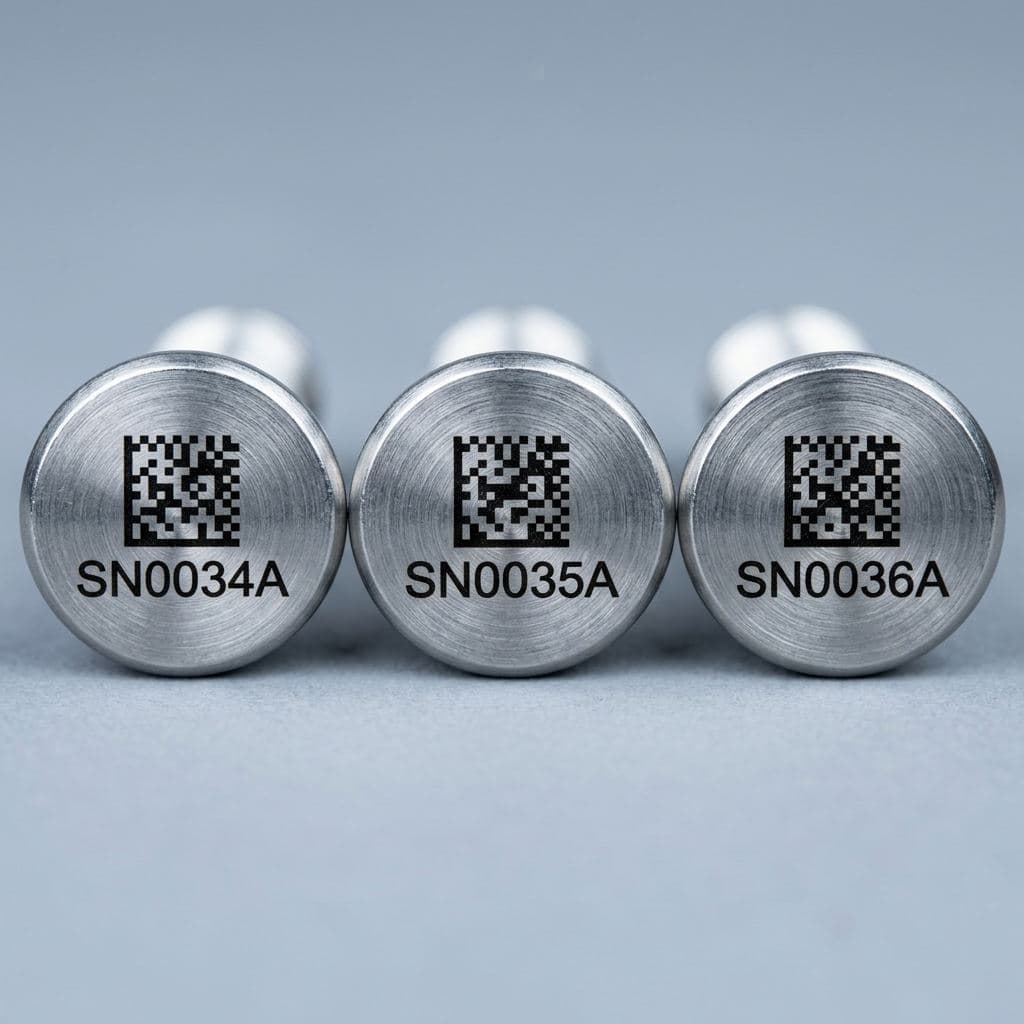
IUID marking for DFARS 252.211-7003 deliverables: ECC 200 Data Matrix laser-marked directly on the part, on a UID label, or on a data plate. We mark the UII data you supply, read every symbol back against it, and return the work with its records. Parts ship in from anywhere in the U.S.

Three identical brushed stainless aerospace fasteners in a row, each laser-marked with a sequential serial number and 2D Data Matrix code — batch serialization in progress.
Marking standard
MIL-STD-130N w/Change 1
Contract clause
DFARS 252.211-7003
Mark methods
Direct part mark · label · data plate
Message syntax
ISO/IEC 15434 · Format 06 or 12
UII
Construct 1 or Construct 2
Verification
100% read and graded
01THE REQUIREMENT

The clause says what gets a UII. The standard says how it is marked.

DFARS 252.211-7003 is the contract clause that makes Item Unique Identification a deliverable. It identifies which delivered items need a Unique Item Identifier (UII), whether by acquisition cost or because the contract names them, and it makes the contractor responsible for marking those items and reporting them.

MIL-STD-130 is the marking standard the clause points to. At a high level it requires a machine-readable mark, an ECC 200 Data Matrix whose contents follow ISO/IEC 15434 syntax, accompanied by human-readable information. The mark has to stay legible for the expected life of the item, through its service environment, cleaning, and overhaul. The standard also sets how symbol quality is measured. It does not choose the marking method: the design activity decides between a direct mark, a label, or a plate, and the drawing records that decision.

We are the marking step in that chain. Which items require IUID, what the UII is, and whether a method is acceptable are decisions for the contractor and the design activity. Your contract and drawing govern; we mark to them and document what was marked. Terms are defined in the glossary.

02MARK METHOD

Direct part mark, UID label, or data plate.

All three can satisfy MIL-STD-130 when they survive the item’s life cycle. The choice comes down to the substrate, the area available, and what the item sees in service.

DPM

Direct part mark

The Data Matrix and its text are laser-marked on the part itself: annealed on stainless steel and titanium with no material removal, etched for contrast on anodized aluminum, or engraved where the drawing calls for depth. No adhesive to qualify, nothing to peel.

Use when

Metal parts with room for the symbol, parts exposed to solvents, heat, or abrasion, and anything that goes through overhaul cleaning.

Marking processes
LBL

UID label

Dual-layer laser-markable acrylate stock, 3M 7847 or tesa Secure 6973. The symbol is ablated into the facestock rather than printed on it, and the label fragments on removal.

Use when

Painted, powder-coated, or plastic enclosures, assemblies that cannot go under the laser, legacy items, and parts where the drawing prohibits a direct mark.

UID labels
PLT

Data plate

A metal identification plate, typically anodized aluminum or stainless steel, laser-marked with the same data set, then riveted or bonded to the item at your facility.

Use when

Drawings that already call for an identification plate, rough castings that will not hold a readable symbol, and nameplates that carry other required data.

Marking aluminum

Substrate drives the process. See the marking notes for stainless steel, titanium, aluminum, and plastics, or use the MIL-STD-130 mark size calculator to check whether a symbol fits the area on your drawing.

03UII DATA

Construct, format, and the text beside the symbol.

CONSTRUCT

Construct 1 or Construct 2

Construct 1 serializes within the enterprise: enterprise identifier plus a serial number never repeated anywhere in the company. Construct 2 serializes within the original part number, lot, or batch: enterprise identifier, part or lot number, then serial. Construct 2 is the usual path for manufactured parts.

FORMAT

Format 06 or Format 12

Both are ISO/IEC 15434 message formats and both derive the same UII. Format 06 qualifies each element with an ASC MH10.8.2 data identifier (17V, 1P, S) and is the default on DoD contracts. Format 12 uses ATA Spec 2000 text element identifiers (MFR, PNO, SEQ) and is called out mainly on aerospace programs. The two are never mixed in one symbol. Build either message in the IUID generator →

HRI

Human-readable information

The drawing defines the text marked beside the symbol, usually the enterprise identifier, part number, and serial number with their data area titles. We mark text and symbol in the same pass from the same data row, so the two cannot disagree. Where a small part cannot carry full text, how far it may be reduced is the design activity’s decision under the standard.

04VERIFICATION

Every symbol read, graded, and matched to its data row.

A Data Matrix that decodes on a handheld scanner is not yet a verified mark. MIL-STD-130 requires symbol quality to be measured, and marks here are graded per ISO/IEC 15415 (or AIM DPM-1-2006 for direct part marks). The minimum acceptable grade comes from the standard and your contract.

100% of serialized codes are read and graded before shipment using a camera-based verifier. The decoded message is compared to the source row for that item, so the envelope, qualifiers, and serial number are confirmed item by item rather than sampled. Failures are reworked or flagged. See how we verify marks.

05WORKFLOW

What you send. What comes back.

You send

  1. 01 · UII data
    Format and construct, enterprise identifier (CAGE or DUNS), part or lot number, and the serial list or range. A CSV with one row per item is ideal.
  2. 02 · Drawing or marking callout
    Method, content, human-readable layout, and any depth or surface limits the design activity has set.
  3. 03 · Mark location
    Position and orientation from the drawing or a marked-up photo. Fixtured placement holds to ±0.005".
  4. 04 · Parts or label details
    Quantity, material, and finish for direct marks; finished size and stock for labels. State handling or ITAR requirements before shipment.

We return

  1. 01 · Marked parts, labels, or plates
    Direct-marked parts returned to you, or labels on the liner in serial order.
  2. 02 · List of UIIs marked
    One row per item, so the data you report matches the hardware you deliver.
  3. 03 · Verification records
    Read and grade results for the symbols, available on request.
  4. 04 · Certificate of Conformance
    On request: substrate, process parameters, operator, date, and verification data.

IUID Registry submission through WAWF / PIEE stays with the contractor under DFARS 252.211-7003. Marking for FDA UDI rather than DoD IUID is covered under medical device marking.

06FREQUENTLY ASKED

MIL-STD-130 marking questions.

What is the difference between UID, IUID, and UII?

IUID (Item Unique Identification) is the DoD program. UID is the common shorthand for the same thing, as in “UID label” or “UID marking.” The UII (Unique Item Identifier) is the string itself: issuing agency code, enterprise identifier, and serial number, with the original part number or lot number between them in Construct 2. MIL-STD-130 is the standard that defines how that string is marked on the item.

Should an item get a direct part mark or a UID label?

Follow the drawing first. When the drawing leaves it open, a direct mark suits metal parts that have room for the symbol and see solvents, heat, or abrasion in service. A label or data plate suits painted and plastic enclosures, rough castings, assemblies that cannot be fixtured under a laser, and items where a direct mark is not permitted. Either can meet MIL-STD-130 when it stays legible for the life of the item; that determination belongs to the design activity.

Does MIL-STD-130 require a specific Data Matrix size?

MIL-STD-130 references ISO/IEC 15415 (and AIM DPM-1-2006 for direct part marks) for symbol grading rather than mandating one module size. Symbol size follows from the data length, the module size the substrate and reader can support, and the quiet zone. The MIL-STD-130 mark size calculator on this site works through that arithmetic for a given UII.

Can you create the UII for us?

We mark the UII data you supply. The enterprise identifier and the serialization scheme belong to the enterprise assigning the UII, and uniqueness is that enterprise’s responsibility. We validate what you send before marking: character set, enterprise identifier format, field lengths, and the 50-character UII limit. The free Data Matrix / IUID generator on this site runs the same checks if you want to test a string first.

Do you submit UIIs to the IUID Registry?

No. Registry submission through WAWF / PIEE is the contractor’s responsibility under DFARS 252.211-7003. We return the list of UIIs we marked so the data you submit matches the parts and labels you received.

How quickly can a MIL-STD-130 marking job turn?

Quotes go out within one business day. Standard jobs are marked, verified, and returned the same week they arrive. First-article quantities and one-off marks for legacy items are routine alongside production lots.

IUID MARKING, SHIPPED IN FROM ANYWHERE

Send the drawing and the serial list. We’ll return verified marks.

Direct part marks, UID labels, or data plates, Format 06 or Format 12. Quotes within one business day; standard jobs return the same week.