
Titanium laser marking,
surface left intact.
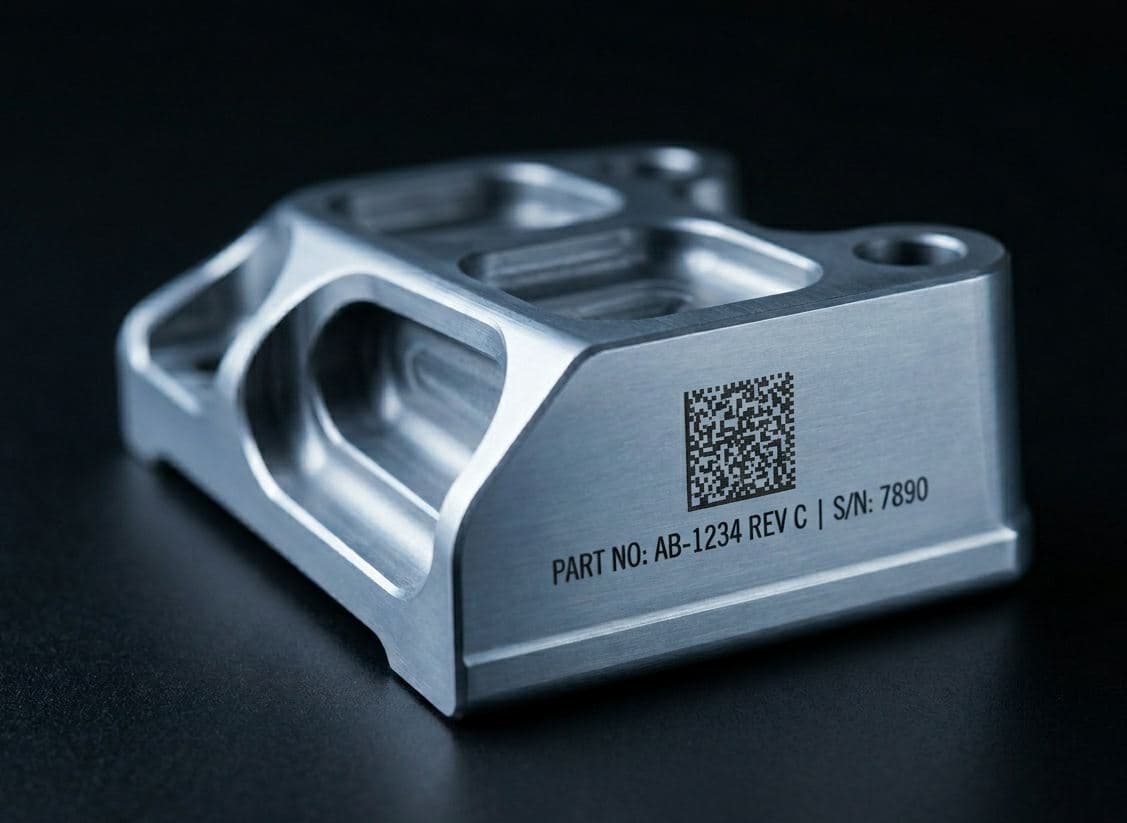
Titanium laser marking is done almost entirely by annealing. Titanium oxidizes readily, so a MOPA fiber laser grows a dark gray to black oxide mark at modest energy, with no measurable material removal. We mark CP Grade 2, Grade 5 (Ti-6Al-4V), and Grade 23 (Ti-6Al-4V ELI) for medical device and aerospace programs, and every code is read back before it ships.
- Primary process
- Anneal
- Contrast
- High · dark gray to black
- Data Matrix readability
- Excellent
- Surface removal
- None measurable
- Also available
- Color · Etch
- Grades
- CP 1–4 · Grade 5 · Grade 23 ELI
Why laser marking titanium means annealing.
Titanium’s affinity for oxygen, the property that makes it awkward to weld, makes it easy to mark. Under controlled heating the surface oxide thickens into a film that reads dark gray to black. The mark is flush with the surface: no recess, no burr, no recast layer.
The same affinity is the reason to keep heat input low. Titanium heated hard in air takes up oxygen below the surface and can form a hardened, brittle layer, and an aggressive etch or a deep engraving also leaves a notch. On fatigue-critical and flight hardware neither is acceptable unless the drawing permits it. Annealing with controlled MOPA pulses (the JPT M7 adjusts pulse width from 2 to 500 ns) puts in enough energy to grow the oxide and no more. Etching and engraving remain available for tooling, fixtures, and non-critical hardware; see capabilities.
Color marking and Data Matrix contrast.
Thin titanium oxide films produce interference colors, so pulse-width control can set the film thickness to give blues, golds, and purples instead of black. Color is used for size coding on orthopedic instrument sets and for branding. Interference colors shift with viewing angle and give a reader less contrast, so machine-readable codes are always marked as a dark anneal and color is kept for human-readable features.
A dark anneal on titanium gives high contrast and excellent Data Matrix readability. Matte finishes (blasted, tumbled, fine-machined) grade most consistently. Codes are graded per ISO/IEC 15415, or AIM DPM-1-2006 for direct part marks, and every serialized code is read back before shipment, as described under quality. Size the symbol with the MIL-STD-130 mark size calculator and mock it up with the Data Matrix generator.
Medical implants and instruments.
Implants and instruments in Grade 23 and Grade 5 need a mark that adds no crevice, sheds nothing, and stays legible through cleaning, passivation, and steam sterilization. An annealed mark is an oxide of the base metal, flush with the surface. Implant drawings typically place it in a low-stress region, consistent with ASTM F86 practice for marking metallic implants. We mark UDI Data Matrix codes, lot and serial numbers, size designations, and logos. Validation of the finished device remains with the manufacturer, and we supply marked samples for it. See medical device marking.
Aerospace and defense hardware.
On airframe and engine-adjacent titanium the marking method and location are usually fixed by the drawing or by the prime’s process specification, and AS9132 covers Data Matrix quality for direct part marks. IUID content follows MIL-STD-130. Where a part cannot take a direct mark, a marked UID plate or a UID label carries the code instead. ITAR-aware handling workflows and Certificates of Conformance are available on request. See aerospace and defense marking.
Grade 2, Grade 5, and Grade 23 ELI.
Marking response is similar across grades; what changes is the program around the part. Stainless steel is annealed the same way, and the material marking guide compares the two.
- CP Grades 1–4
- Commercially pure titanium, Grade 2 being the most common, anneals to a uniform dark mark. Used in chemical-process hardware, housings, and some implant components (ASTM F67).
- Grade 5 · Ti-6Al-4V
- The standard aerospace alloy. Anneals dark and consistent on machined, blasted, and tumbled finishes.
- Grade 23 · Ti-6Al-4V ELI
- The extra-low-interstitial implant grade (ASTM F136). Marking response matches Grade 5; the difference is the documentation and handling the program requires.
- Anodized titanium
- Color-anodized and gray-anodized parts mark differently from bare metal because the laser is working on an existing oxide. Send a sample in the production finish.
Typical applications
- Orthopedic implants
- Surgical instruments and instrument sets
- Size and color coding
- Aerospace brackets and fittings
- Fasteners
- UID plates
Calling out the mark on a drawing.
On titanium the note should exclude the processes you do not want as clearly as it names the one you do, and it should fix the location. Typical notes:
- NOTE 01LASER ANNEAL PER ARTWORK. NO MATERIAL REMOVAL. ENGRAVING AND ETCHING NOT PERMITTED.
- NOTE 02MARK IN LOW-STRESS AREA SHOWN. DATA MATRIX ECC 200 PER AS9132.
- NOTE 03MARK AFTER FINAL SURFACE FINISH AND PRIOR TO PASSIVATION.
Example wording only; your drawing standard and the governing specification control. Terms are defined in the glossary. If the drawing is silent on method, send it with the RFQ and we will propose the process and location for your approval.
Titanium marking questions.
Does laser marking affect the fatigue life of titanium?
It depends on the process. Deep engraving and aggressive etching leave a notch and a heat-affected layer, which is why they are avoided on fatigue-critical and flight hardware unless the drawing permits them. Annealing is non-intrusive: it grows an oxide film with no measurable material removal. We do not publish fatigue data. Where a program requires it, the design authority qualifies the marked part on samples we supply, and the drawing fixes the method and location.
Can you mark Grade 23 (Ti-6Al-4V ELI) implants?
Yes. Grade 23 anneals the same way as Grade 5, to a dark, flush mark suitable for UDI Data Matrix codes, lot numbers, and size designations. The mark goes where the drawing places it, typically a low-stress region. Validation of the finished implant remains with the device manufacturer; we supply marked samples and Certificates of Conformance on request.
Which colors can be laser marked on titanium, and can a Data Matrix be in color?
MOPA pulse-width control produces interference colors on titanium, including blues, golds, and purples, by setting the oxide film thickness. Color works well for size coding and branding. It is not recommended for a Data Matrix: interference colors change with viewing angle and give a reader less contrast, so codes are marked as a dark anneal.
Will the mark survive passivation and steam sterilization?
An annealed mark on titanium is a stable oxide film and is intended to stay legible through passivation and repeated steam sterilization. Tell us what follows marking so parameters are tuned for it, and confirm on first articles. Post-process verification of Data Matrix codes is available on request.
How is marking titanium different from marking stainless steel?
Both are annealed, and both give a dark, flush, high-contrast mark. Titanium oxidizes more readily, so it marks at lower energy and produces stronger interference colors. The main caution differs too: on stainless the concern is corrosion at an overheated mark, while on titanium it is fatigue performance, which is why engraving is kept off critical titanium parts.
Send the drawing. We’ll return marked, verified parts.
Quotes within one business day. Same-week turnaround on standard jobs, with Certificates of Conformance on request.