
Medical device
laser marking.
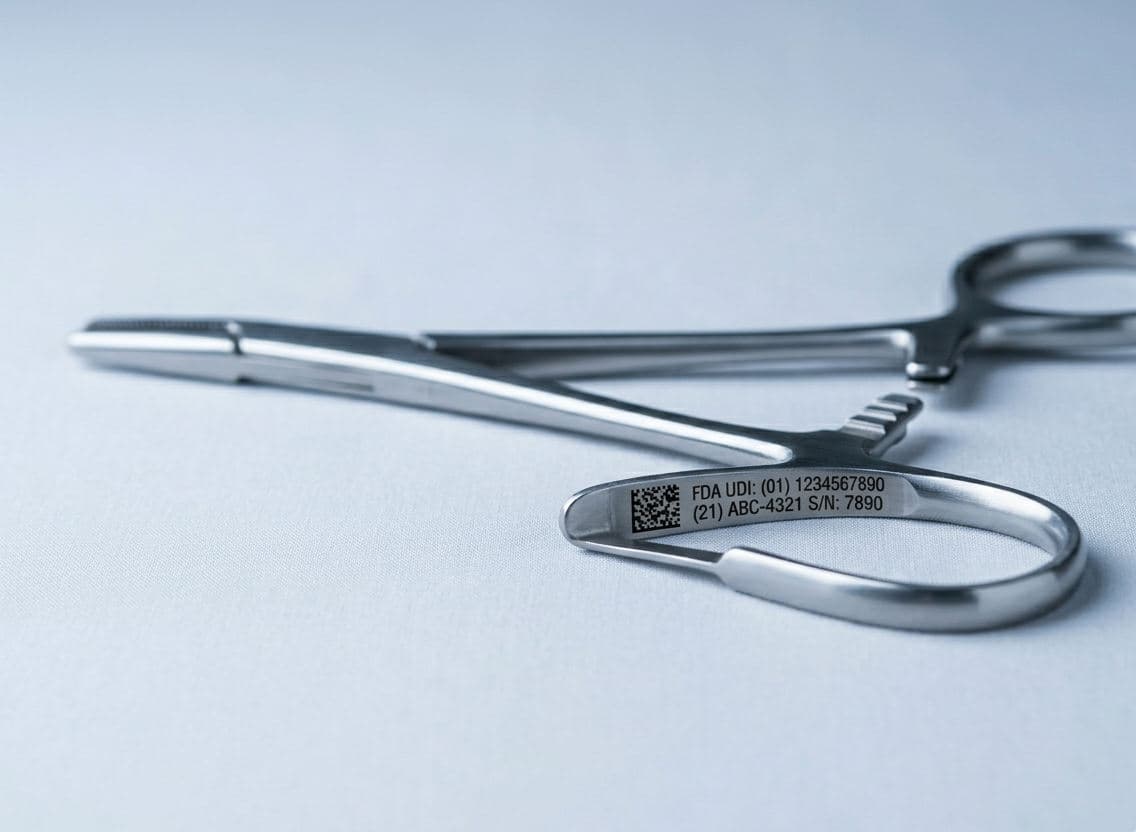
UDI direct marks, annealed and verified.
Laser-annealed UDI direct marks on surgical stainless steel and titanium instruments and components. No material removal, no inks or chemicals, and every Data Matrix read back against the data you supply before the parts return to your process. Parts ship in from anywhere in the U.S.
- Primary process
- Laser annealing · no material removal
- Substrates
- Surgical stainless · titanium · engineering plastics
- UDI carriers
- GS1 DataMatrix · HIBC
- Laser source
- JPT M7 MOPA fiber · 2–500 ns MOPA
- Placement
- ±0.005" fixtured
- Verification
- 100% read and graded
Annealing marks the surface without cutting into it.
Annealing uses the fiber laser to heat the surface of stainless steel or titanium just enough to grow a controlled oxide layer. The result is a dark, permanent mark with no engraved trough: nothing is removed, so there is no recess to hold soil and no raised burr at the edge of a character. It is the usual process for surgical instrument laser marking and for reusable device components.
The MOPA source is what makes this controllable. Pulse width (2–500 ns MOPA) and pulse frequency are set independently, so heat input is tuned to the alloy and the section thickness: enough to produce a dark oxide, not so much that the surface roughens. 300-series and 17-4 stainless steel and Grade 2 and Grade 5 titanium each take different settings. Titanium oxidizes readily and marks dark at modest energy. Polymer components such as PEEK and PEI are marked with a different process; see plastics.
Annealed marks are passivation-friendly because the base metal is left intact, and they are made to survive autoclaving and cleaning cycles. How a mark behaves through your specific passivation chemistry and reprocessing cycle is something your process validation should confirm. We mark sample coupons or scrap instruments for that testing before production.
The labeler owns the UDI data. We mark it.
The FDA UDI rule requires a permanent UDI on the device itself when the device is intended to be used more than once and reprocessed before each use, because the label and packaging do not stay with it. The rule has exceptions. Deciding whether a device needs an FDA UDI direct mark, or qualifies for an exception, belongs to the device labeler and its regulatory function.
A UDI has two parts: the device identifier, which identifies the labeler and the specific version or model, and production identifiers such as lot, serial number, manufacturing date, and expiration date. The data is issued under an FDA-accredited issuing agency, most often GS1 or HIBCC, and is typically carried on the part as a GS1 DataMatrix or an HIBC-formatted Data Matrix, with human-readable text where space allows.
Utah Marking does not assign device identifiers, choose production identifiers, or submit records to GUDID. You supply the exact string or the field values per part; we encode, mark, and verify exactly that. Nothing on this page is regulatory advice. For DoD IUID rather than FDA UDI, see MIL-STD-130 marking services.
Small Data Matrix symbols that still read.
Instrument real estate is limited: a box lock, a shank flat, the side of a handle. Symbol size is a function of data content, module size, and quiet zone, so the first question is how many characters the UDI string carries. What it must contain is the labeler’s decision.
Beam quality of M² < 1.5 gives a tight focused spot for small modules with clean edges, and fixtured placement holds to ±0.005" so the symbol lands on the flat it was designed for. On narrow shafts, a rectangular Data Matrix run along the axis keeps the symbol out of the curvature. The mark size calculator covers square ECC 200 symbols, and its sizing arithmetic applies to any Data Matrix, not only MIL-STD-130 marks.
Surface finish matters as much as size. Satin and bead-blasted finishes generally read more reliably than mirror polish, where specular reflection can wash out contrast under some readers. Tell us the finish, and the reader used in reprocessing or at the point of use if you know it.
A marking step inside your quality system.
We are a marking subcontractor, not a finished-device manufacturer. Parts are returned as marked and non-sterile, and laser marking is normally placed upstream of your final cleaning, passivation, and sterilization steps. Handling requirements are customer-driven: put glove, tray, lot-segregation, and packaging requirements on the RFQ or purchase order and they are carried on the job.
100% of serialized codes are read and graded before shipment using a camera-based verifier, graded per ISO/IEC 15415 (or AIM DPM-1-2006 for direct part marks), and the decoded data is compared to your source row for that part. Certificates of Conformance are available on request and document substrate, process parameters, operator, date, and verification data. See quality and verification for the detail, or the glossary for the terms.
Six inputs for a UDI laser marking quote.
Quotes go out within one business day. Validation samples can be marked ahead of any production lot.
- 01 · UDI dataThe exact string as your labeling system generates it, or the field values per part. A CSV with one row per part for serialized lots.
- 02 · Carrier and textGS1 DataMatrix or HIBC, square or rectangular symbol, and any human-readable text that accompanies it.
- 03 · Drawing and mark locationMark position, orientation, and the area available, from the drawing or a marked-up photo.
- 04 · Material and finishAlloy and condition, surface finish (satin, bead-blast, polish), and where marking sits relative to passivation.
- 05 · Handling requirementsGloves, tray orientation, lot segregation, and packaging. Stated on the RFQ, carried on the job.
- 06 · Quantity and need dateValidation samples, first articles, or production lots. Standard jobs return the same week.
Medical device marking questions.
Does laser annealing affect corrosion resistance or passivation?
Annealing grows a dark oxide layer at the surface and removes no material, so the base metal stays intact. That is why it is described as passivation-friendly and why it is the usual process for surgical stainless. Heat input still matters: too much energy can roughen the surface and reduce corrosion resistance, so parameters are tuned to the alloy and section. Your process validation should include the corrosion and passivation testing your quality system requires; we can mark sample coupons for it.
Will an annealed mark survive autoclaving and cleaning cycles?
An annealed mark is an oxide grown from the part’s own surface, not an ink or coating, and it is made to withstand repeated autoclave and cleaning cycles. Aggressive chemistries and abrasive cleaning can lighten any oxide mark over time, so durability should be confirmed on your instrument, with your reprocessing cycle, as part of validation. We supply marked samples for that purpose.
Which UDI carrier do you mark, GS1 DataMatrix or HIBC?
Either. Both are carried in an ECC 200 Data Matrix symbol. GS1 DataMatrix uses GS1 application identifiers such as (01) for the GTIN, (10) for lot, (17) for expiration date, and (21) for serial number. HIBC uses the HIBCC data structure. Your issuing agency and labeling system determine which applies. Send the string exactly as it should be encoded and we read every mark back against it.
Do you assign UDIs or submit to GUDID?
No. The device labeler obtains device identifiers from its issuing agency, decides which production identifiers apply, and submits device records to the FDA’s GUDID database. We mark and verify the data you supply. Whether a device requires a direct mark, or qualifies for an exception, is the labeler’s regulatory decision.
How small can the Data Matrix be on an instrument?
It depends on the number of characters encoded, the surface finish, and the reader used at the point of use. A shorter string needs fewer modules and a smaller symbol. Send the data string and the available area; we will propose a symbol and module size and mark a sample that you can read on your own equipment before committing to production.
Are parts returned clean or sterile?
Parts are returned as marked and non-sterile. Laser marking uses no inks, acids, or electrolytes, and it is normally placed upstream of your final cleaning, passivation, and sterilization steps. Handling and packaging requirements are customer-driven: state them on the RFQ or purchase order.
Send the UDI string and a sample part. We’ll return a verified mark.
Annealed marks on stainless and titanium, GS1 DataMatrix or HIBC, samples for validation before production. Standard jobs return the same week.