
ANN
Annealing
A dark oxide mark grown on stainless steel or titanium with no material removal and no recess. The least intrusive laser mark, and the one most often specified where surface integrity matters.
Permanent laser traceability marks for airframe, powerplant, and defense subcomponents: part numbers, serial numbers, and ECC 200 Data Matrix, including MIL-STD-130 IUID. The marking method follows your drawing, every serialized symbol is read and graded, and the job is documented. Parts ship in from anywhere in the U.S.
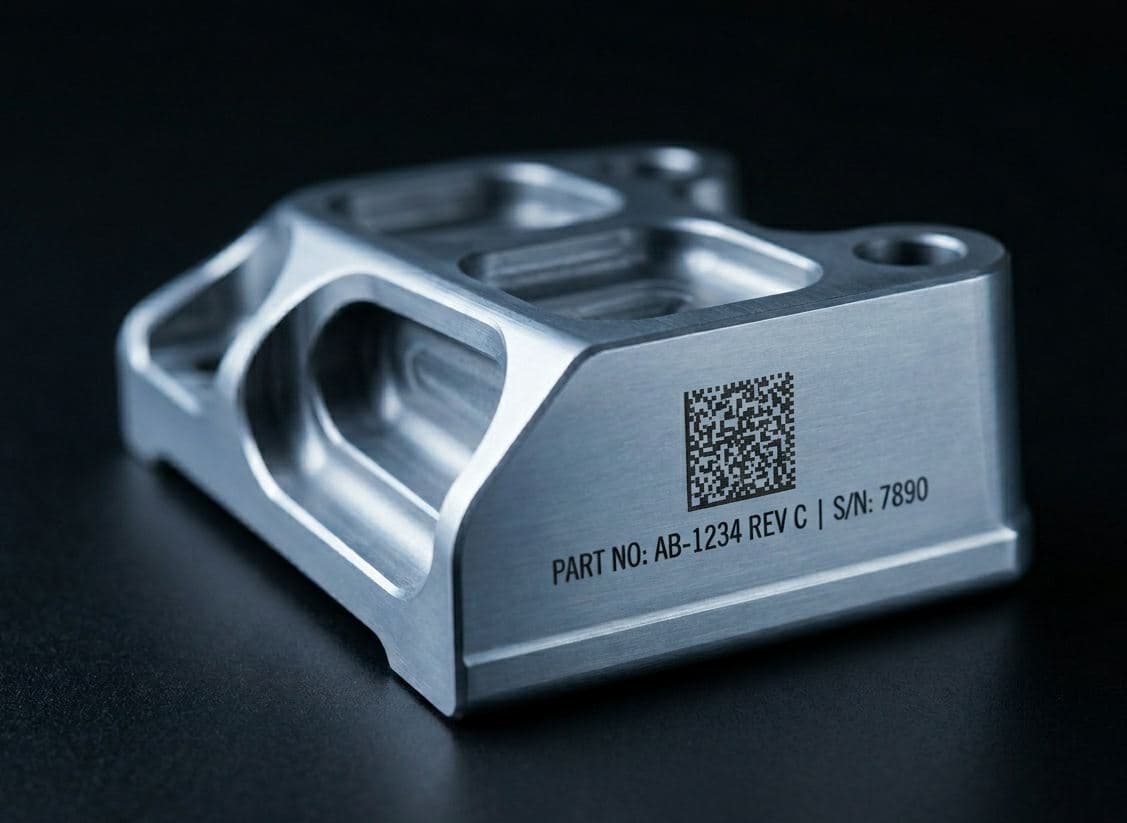
Aerospace part marking exists so that a component can be tied back to its part number, serial number, lot, and manufacturer at any point in its life. Tags and ink do not survive cleaning, heat treat, coating, and service environments, which is why drawings call for a direct part mark: the identification is made in the part’s own surface.
We laser-mark text, serial numbers, lot and heat codes, CAGE codes, and ECC 200 Data Matrix symbols on machined and formed components, with sequential data driven from your serial list. Common substrates are titanium, raw and anodized aluminum, 300-series and 17-4 stainless steel, and engineering plastics such as PEEK and PEI. Precision jigs are designed per part for repeat runs, so mark location and orientation stay consistent batch over batch, within ±0.005" once fixtured.
For CNC shops, marking fits as an outside operation on the router, between final finishing and shipment to the prime. See capabilities for the processes and the other industries we serve.
Three laser processes cover most aerospace laser marking. They differ in how much they disturb the surface, and that difference is what the drawing controls.
A dark oxide mark grown on stainless steel or titanium with no material removal and no recess. The least intrusive laser mark, and the one most often specified where surface integrity matters.
A shallow, high-contrast surface mark. On anodized aluminum it produces a bright symbol against the dark anodic layer, the highest-contrast Data Matrix of any common substrate.
A recessed mark built up in controlled passes. It survives coatings, blasting, and rework, and it removes material to do so. Used only where the drawing permits a depth.
On fatigue-critical hardware any of these can matter. A recessed mark is a geometric discontinuity, and even a no-removal mark puts heat into the surface. That is why aerospace drawings specify the method, place the mark in a low-stress area, and sometimes limit depth. We mark to that callout and do not substitute one method for another. If the drawing is silent we ask rather than assume, and the answer has to come from your engineering authority.
SAE AS9132 is the aerospace standard for Data Matrix quality on direct part marks. It addresses how the symbol is formed and measured, and it leaves the permitted process and surface effect to the design authority. When your drawing or purchase order invokes AS9132, state it on the RFQ together with any reporting you need. It does not change symbol sizing arithmetic, so the mark size calculator still applies.
Defense part marking under DFARS 252.211-7003 means a MIL-STD-130 IUID mark: an ECC 200 Data Matrix carrying the Unique Item Identifier in an ISO/IEC 15434 message, with human-readable information beside it. We apply it as a direct part mark, or on a UID label where the item cannot take one. The full service, including how to choose between them, is described under MIL-STD-130 marking services.
Aerospace programs that already mark parts to ATA Spec 2000 usually call out Format 12, which qualifies each data element with a text element identifier (MFR, PNO, SEQ) instead of the Format 06 data identifiers (17V, 1P, S) used on most DoD contracts. The UII a reader derives is identical. We mark both and never mix them in one symbol. The Data Matrix / IUID generator builds either message from your CAGE, part number, and serial so the string can be checked before it is marked.
We handle parts under customer-driven ITAR compliance workflows. Reach out to discuss your program requirements before shipment, and before sending drawings or technical data.
100% of serialized codes are read and graded before shipment using a camera-based verifier, graded per ISO/IEC 15415 (or AIM DPM-1-2006 for direct part marks). Each decoded message is compared to its source data row, so a transposed serial is caught at the machine, not at receiving inspection. Failures are reworked or flagged.
Certificates of Conformance are available on request and document substrate, process parameters, operator, date, and verification data. See quality and compliance for the verification process and the glossary for terms.
The one on the drawing. Annealing removes no material and is the least intrusive option on stainless steel and titanium, which is why it is commonly specified. An engraved mark is a recess and therefore a geometric feature the stress analysis has to accept. Method, location, and any depth limit are set by your engineering authority. We mark to that callout and do not substitute methods; if the drawing is silent, we ask before marking.
AS9132 is the SAE aerospace standard for Data Matrix quality on direct part marks. When your drawing or purchase order invokes it, state that on the RFQ along with the reporting you need, and we will confirm what we can measure and report before quoting. Marks here are read and graded with a camera-based verifier per ISO/IEC 15415 (or AIM DPM-1-2006 for direct part marks).
When the contract, drawing, or prime specifies it. Format 12 qualifies the UII data elements with ATA Spec 2000 text element identifiers such as MFR, PNO, and SEQ, and is called out mainly on aerospace programs that already mark parts to Spec 2000. Format 06 uses ASC MH10.8.2 data identifiers (17V, 1P, S) and is the default on DoD contracts. Both derive the same UII and the two are never mixed in one symbol.
We handle parts under customer-driven ITAR compliance workflows. Reach out to discuss your program requirements before shipment.
Certificates of Conformance are available on request and document substrate, process parameters, operator, date, and verification data. For IUID work we also return the list of UIIs marked, so the data the contractor reports through WAWF / PIEE matches the hardware. IUID Registry submission remains the contractor’s responsibility.
Use a UID label or a data plate. We laser-mark MIL-STD-130 labels on 3M 7847 and tesa Secure 6973 acrylate stock for painted, coated, composite, and plastic items, and for assemblies that cannot be fixtured under the laser. Whether a label is acceptable for a given item is the design activity’s decision.
Quotes within one business day. Standard jobs are marked, verified, and returned the same week.