Laser marking stainless steel,
with nothing removed.
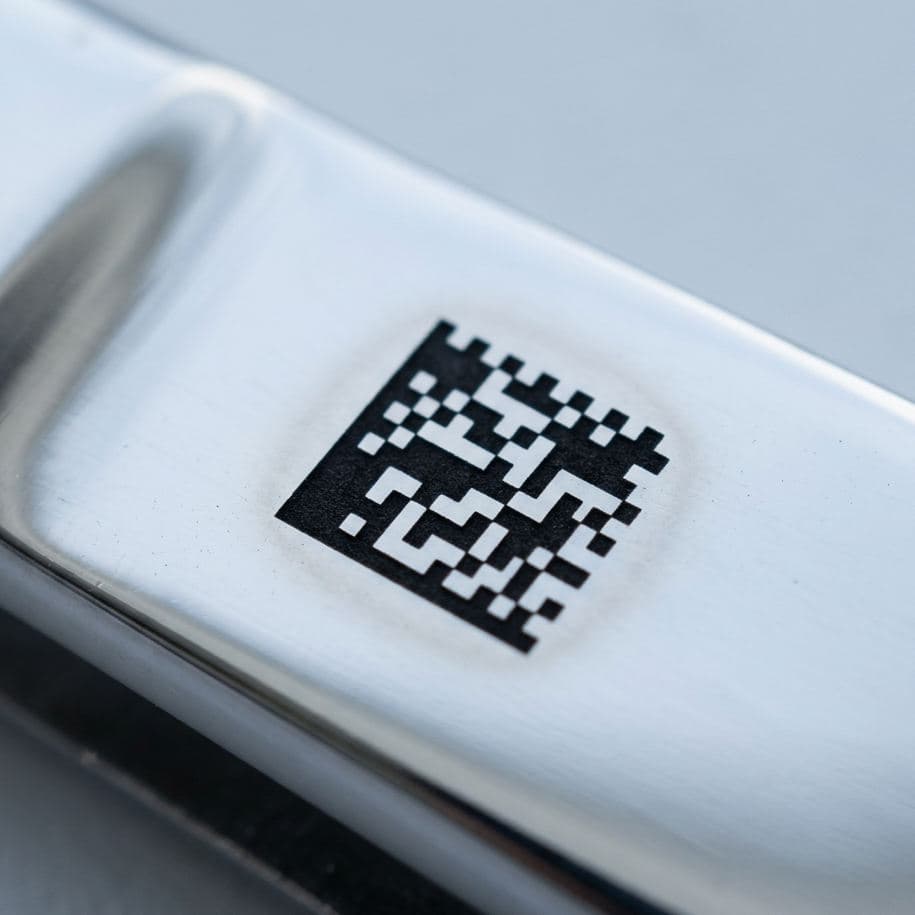
Laser marking stainless steel is mostly a question of what the mark does to the passive layer. Our default is laser annealing: a black oxide mark grown in the surface of 303, 304, 316/316L, and 17-4 PH with no measurable material removal, so the part stays smooth, cleanable, and ready for passivation. Serial numbers, UDI content, and Data Matrix codes are read back 100% before parts ship.
- Primary process
- Anneal
- Contrast
- High · black on metal
- Data Matrix readability
- Excellent
- Surface removal
- None measurable
- Also available
- Etch · Engrave · Color
- Post-processing
- Passivation-compatible
Laser annealing stainless steel: an oxide mark, not a cut.
Annealing heats the surface in a controlled pattern to a temperature below melting. The metal at the surface oxidizes, and the resulting film reads as a deep black. Nothing is vaporized: there is no recess, no burr, and no recast edge to trap soil or start a crevice. Run a fingernail across an annealed mark and there is nothing to feel.
The MOPA source is what makes this repeatable. The JPT M7 gives independent control of pulse width, from 2 to 500 ns, and of pulse frequency, so heat input can be set high enough to form a complete oxide layer and low enough to avoid melting the surface. The same control produces stable interference colors (blue, gold, bronze) where a drawing calls for color coding. Capabilities lists the equipment and the other mark types.
Etching and engraving remain available when the application calls for them: a gray-to-white etch for cosmetic branding, or a recessed engraving on tooling and hardware that will be blasted, coated, or worn. Both remelt or remove material, so on corrosion-critical parts they are the exception. The material marking guide compares the processes side by side.
Passivation-safe marking, in the right sequence.
Stainless resists corrosion because of a thin, chromium-rich passive film. A mark that melts or removes the surface disturbs that film, and etched areas can show rust bloom in service. An annealed mark keeps the surface intact, which is why it is the standard mark on parts passivated to ASTM A967 or AMS 2700. It still puts heat into the surface, so parameters matter. Too much energy and the mark can rust after passivation or sterilization; too little and the oxide is thin enough for the acid bath to fade it.
A fully formed annealed mark generally survives citric and nitric passivation. Marking can sit on either side of passivation in the router. Mark first, and the bath restores the passive film over the whole part, mark included. Mark last, and the code is verified in its final condition. Follow the drawing or process specification where it fixes the order, and state on the RFQ what happens to the parts after they leave us so the parameters are tuned for it. Post-passivation verification is available on request.
Reusable surgical instruments add repeated cleaning and steam sterilization, and the UDI Data Matrix has to stay readable throughout. That is the use case annealing was adopted for. See medical device marking for UDI content and quality for how codes are graded.
Contrast and Data Matrix readability.
A black annealed mark on bright stainless gives high contrast, and Data Matrix readability is excellent on most finishes. Finish matters more than grade. Bead-blasted, satin, and ground surfaces scatter light evenly and grade consistently. Mirror-polished and electropolished surfaces are specular: the mark is just as black, but a reader sees glare unless the lighting is angled, so module size is chosen with margin. Annealed marks also shift slightly in apparent darkness with viewing angle. That is a property of thin oxide films, not a defect.
Every serialized code is read back and graded per ISO/IEC 15415, or AIM DPM-1-2006 for direct part marks, before shipment. To size a symbol for an instrument shank or a fastener head, use the MIL-STD-130 mark size calculator. To mock up the code for a drawing, use the Data Matrix generator.
303, 304, 316, 17-4: grade and condition notes.
All common stainless grades anneal to a dark mark. The differences are in corrosion margin and in where marking belongs in the router. Titanium is marked the same way and is covered separately.
- 304 / 304L
- Anneals to a uniform black. The baseline grade for parameter development.
- 316 / 316L
- Anneals cleanly. The usual choice for surgical, food-contact, and fluid-handling parts that will be passivated.
- 303
- Free-machining sulfur additions make 303 the most passivation-sensitive of the austenitic grades. It anneals well; tell us which passivation method follows.
- 17-4 PH / 15-5 PH
- Mark after precipitation hardening, on the finished surface. An annealed mark is an oxide film and can change if the part is later heated to aging temperature.
- 410 / 420 / 440C
- Martensitic grades anneal dark but carry less corrosion margin than the 300 series. Conservative parameters and passivation after marking are typical.
Typical applications
- Surgical instruments
- Reusable-device UDI marks
- Implants
- Fasteners and fittings
- Valve bodies and manifolds
- Food-grade components
- Stainless nameplates
Calling out the mark on a drawing.
State the method, the content, the location, and whether surface removal is permitted. A note that says only LASER MARK leaves the process to the shop, and shops choose differently. Typical notes:
- NOTE 01LASER ANNEAL PER ARTWORK. NO SURFACE REMOVAL. LOCATE APPROX AS SHOWN.
- NOTE 02MARK PRIOR TO PASSIVATION PER ASTM A967. MARK SHALL REMAIN LEGIBLE AFTER PASSIVATION.
- NOTE 03DATA MATRIX ECC 200, CONTENT PER [SPEC]. VERIFY 100%.
Example wording only; your drawing standard and the governing specification control. For defense hardware, content and mark quality follow MIL-STD-130. Unfamiliar term? The glossary defines annealing, passivation, and the verification standards. No drawing note yet? Send the drawing and we will propose one.
Stainless steel marking questions.
Does laser annealing remove material from stainless steel?
No. Annealing heats the surface below its melting point to grow a dark oxide film. There is no measurable surface removal, no recess, and no burr, which is the reason it is the default mark for surgical instruments, implants, and other corrosion-critical stainless parts. Etching and engraving do remelt or remove material and are used only where the drawing calls for them.
Will an annealed mark survive passivation?
A fully formed annealed mark generally survives citric or nitric passivation per ASTM A967 or AMS 2700, because the oxide layer is chemically stable. Under-formed marks can fade in the bath, and etched marks can fade if the bath attacks the re-solidified layer. When parts will be passivated after marking, specify annealing, tell us the passivation method, and ask for post-passivation verification.
Should stainless parts be marked before or after passivation?
Either sequence is used. Marking before passivation lets the bath restore the passive film over the whole part, including the marked area. Marking after passivation means the code is verified in its final condition. If the drawing or a customer process specification fixes the order, follow it. If it does not, tell us the planned sequence on the RFQ and we will tune parameters for it.
Will the mark rust or fade in an autoclave?
A correctly annealed mark is intended for repeated cleaning and steam sterilization, and it is the standard mark on reusable surgical instruments. Rust at a mark usually points to excess heat input or to an etched mark where an annealed one was needed. Validation of the finished device remains with the manufacturer; we supply marked samples for that testing.
Can you mark a Data Matrix on mirror-polished or electropolished stainless?
Yes. The annealed mark is as dark on a polished surface as on a matte one, but polished stainless is specular, so a reader needs angled or diffuse lighting to avoid glare. We size the modules with margin for the finish and grade every code per ISO/IEC 15415, or AIM DPM-1-2006 for direct part marks, before shipment.
Send the drawing and the passivation spec.
Quotes within one business day. Same-week turnaround on standard jobs, with Certificates of Conformance on request.