Skip to content
Utah Marking — Industrial Marking & Traceability
AUTOAUTOMOTIVE & POWERTRAIN MARKING

Automotive
part marking,
built to survive the router.

Laser Data Matrix, serial, and lot marks on gears, housings, fittings, and transmission components, for IATF 16949 traceability and PPAP lot control. Placed and processed to read after heat treat, machining, oil, and e-coat, with every serialized code read back against your list before it ships. Parts ship in from anywhere in the U.S.

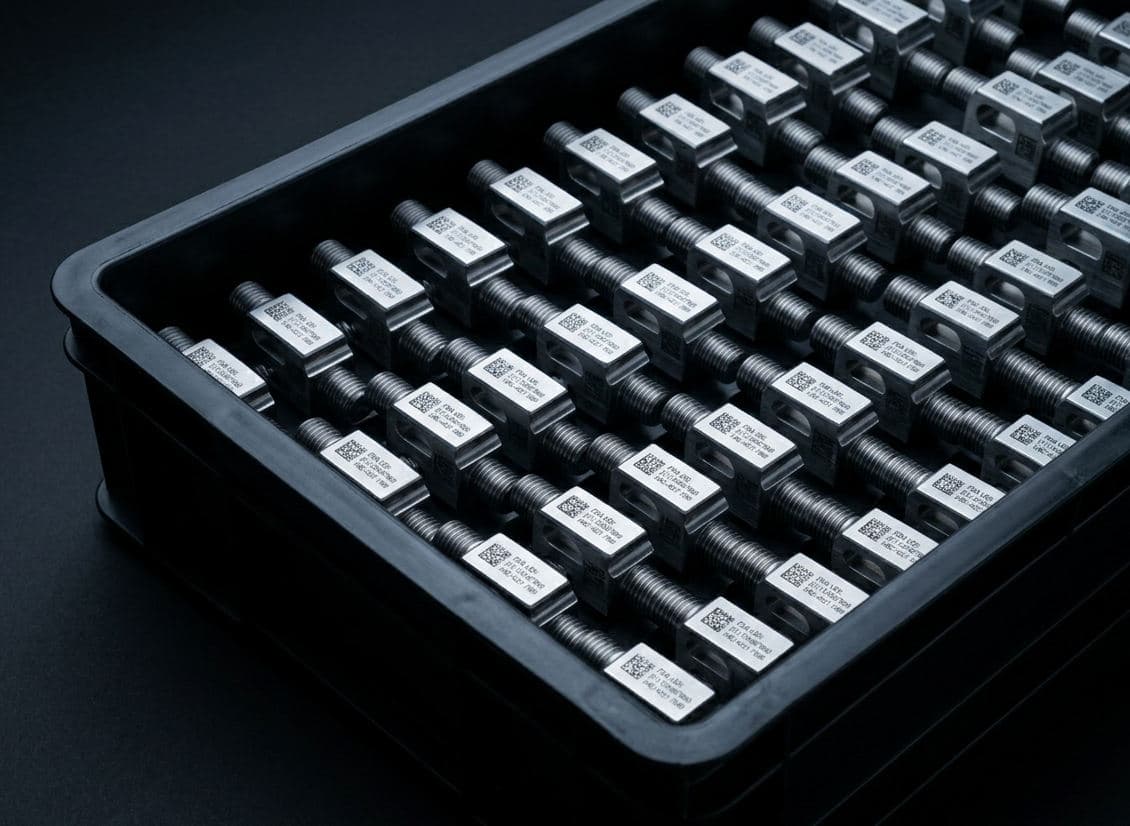
Industrial tote packed with rows of identical serialized steel fittings, each laser-marked on its flat with a Data Matrix code and a sequential identification block.
Program references
IATF 16949 · PPAP · AIAG B-4 / B-17
Symbologies
Data Matrix ECC 200 · QR · HRI
Processes
Etch · anneal · deep engrave
Substrates
Steel · cast & anodized Al · brass · plastics
Placement
±0.005" fixtured
Documentation
CoC + read-back results on request
01TRACEABILITY

The mark is what makes a recall a lot instead of a model year.

IATF 16949 requires that product be identified and traceable through production and into the field, and PPAP ties every production part back to its lot, date, and process data. A permanent, machine-readable mark on the part is how that paperwork survives contact with the real world: when a defect is isolated to a shift or a heat lot, the parts carrying that code can be found and the rest left alone.

The content is usually a part number, supplier or plant code, date or shift code, and a serial or lot number, carried in an ECC 200 Data Matrix with human-readable text beside it. AIAG B-4 covers the symbologies for automotive part identification and AIAG B-17 is the guideline for marking Data Matrix and QR directly on parts. Your customer-specific requirements set the content; we mark it, and read every code back against your list before shipment.

Substrate notes for the common powertrain materials are under stainless steel, aluminum, and plastics; carbon and alloy steels, tool steels, and brass are in the material marking guide.

02DOWNSTREAM PROCESSES

Four things that erase marks, and how the mark is placed to survive them.

Where marking sits in the router decides the process. Tell us what the part sees after the laser and we recommend etch, anneal, or engraving, then prove it on a sample.

HT

Heat treat and shot peen

Carburizing, nitriding, and induction hardening change the surface; shot peen hammers it. A shallow etch marked before those operations can lose contrast or disappear. Where the router puts marking ahead of heat treat, we recommend a recessed engraving sized to survive the stock loss, or moving the mark after peen if the drawing allows. Case-hardened surfaces mark fine afterward; we check hardness limits before engraving into case.

MCH

Machining, coolant, and oil

Marks go on a surface that is not machined after marking, or on a pad the drawing reserves for identification. A laser mark has no ink or fill, so coolant, cutting oil, transmission fluid, and engine oil cannot lift it. An annealed or etched steel mark reads through an oil film; an engraved mark reads after a wipe.

ECT

E-coat, paint, and plating

A code marked before e-coat or paint usually will not read through it. For brackets and housings that are coated, the mark is applied after coating by ablating the coating back to bright metal, which gives the highest contrast on the part. Where corrosion protection must be continuous, the mark goes under the coat as an engraving deep enough to read through, and we test that on a sample first.

SVC

Years in service

Recall and warranty traceability only works if the code still reads when the part comes back. Laser marks on steel, cast aluminum, and brass are permanent changes to the material; there is nothing to fade, peel, or wash off. Module size is set with margin for the wear the surface will see.

For what each process does to the surface, see the guide to laser annealing vs etching vs engraving.

03COMPONENTS

Powertrain, chassis, and under-hood components.

Gears, shafts, and splines

Substrate

Carburized and through-hardened alloy steel (8620, 4140, 4340)

The mark

Data Matrix and serial on a face or shoulder clear of the tooth form. Engraved ahead of heat treat; etched or annealed after. Fixtured on the bore so every part marks in the same clock position.

Engine blocks, heads, and housings

Substrate

Cast aluminum and cast iron

The mark

Lot, date, and serial on a machined pad, since as-cast surfaces show porosity in a code. Transmission cases and valve bodies carry the serial that ties the assembly to its leak test and build record.

Brake, fuel, and hydraulic line fittings

Substrate

Steel, brass, and stainless

The mark

Part number, supplier code, and date code on a hex flat or flange, high-volume in multi-part fixtures. Small Data Matrix symbols sized for the flat and the reader.

Transmission and driveline components

Substrate

Hardened steel, powder metal, cast aluminum

The mark

Clutch plates, planetary carriers, valve bodies, and yokes marked for assembly-level traceability. Powder-metal parts etch well on sintered surfaces once the module size is set for the texture.

Fasteners, brackets, and stampings

Substrate

Plated and coated steel, aluminum

The mark

Grade and manufacturer marks on heads, serials and part numbers on brackets. Marked through the coating for contrast or under it for corrosion continuity, per the drawing.

Sensors, connectors, and housings

Substrate

Anodized aluminum, engineering plastics (PA, PBT, PC/ABS)

The mark

Part number, revision, and Data Matrix on anodized bodies, and on plastics that respond to a 1064 nm fiber laser or carry a laser-marking additive. Coupon qualification first on new resins.

04HOW A RUN GOES

Fixture once. Run it every release.

Parts are fixtured for repeatable placement at ±0.005", serials run from your list, and every code is scanned and checked against its row before packing. The fixture and program stay on file, so repeat releases skip setup. A Certificate of Conformance with read-back results is available on request.

  1. 01 · Drawing or marking spec
    Content, location, method, and any depth or no-mark zones. If your customer-specific requirements call out AIAG B-17 or a verification grade, include that.
  2. 02 · Serial or lot list
    A CSV with one row per part, or the scheme (prefix, date code, sequence) and we generate it. The free serial number generator on this site produces a ready list.
  3. 03 · Where marking sits in your router
    Before or after heat treat, peen, machining, and coating. It decides the process and depth we recommend.
  4. 04 · Parts, fixtures, and schedule
    Quantity, packaging, and need date. Repeat jobs keep their fixture and program on file, so a re-order runs without setup questions.

Build the list with the serial number generator, check symbol size with the mark size calculator, and see how we verify marks.

05FREQUENTLY ASKED

Automotive part marking questions.

Will the mark survive heat treatment?

It depends on which mark and where it sits in the router. A recessed engraving survives carburizing, hardening, and shot peen when its depth exceeds the stock the process removes or displaces, and we size it for that. A shallow etch or anneal is better applied after heat treat and peen, where it reads at full contrast. Tell us the router sequence and the hardness spec and we will recommend the process, then prove it on a sample part before the production run.

Can you mark through e-coat or paint?

Yes. Ablating the coating back to the metal gives a bright code on a dark background, the highest contrast available on a coated part. The trade-off is a bare-metal window, so where the drawing requires continuous corrosion protection, the alternative is an engraving under the coat, verified on a coated sample to confirm it still reads.

How small can a Data Matrix be on a fitting or a gear face?

Smaller than most readers prefer. The practical limit is the reader, not the laser: an ECC 200 symbol carrying a part number and serial fits comfortably on a 1/4 in. hex flat, and the free MIL-STD-130 mark size calculator on this site shows the symbol size for any data string. We set module size with margin for the surface texture and the scanners on your line.

Does laser marking meet IATF 16949 and AIAG requirements?

IATF 16949 requires identification and traceability (clause 8.5.2) but does not prescribe a marking method; PPAP requires parts be traceable to lot and production data. AIAG B-4 covers part identification symbologies and B-17 is the 2D direct part marking guideline for Data Matrix and QR by laser, dot peen, and inkjet. Laser Data Matrix is squarely within those documents. Your customer-specific requirements govern the content and any quality grade; let us know on the RFQ if graded verification is called for. Every serialized code we mark is scanned and its decoded data checked against the source row before shipment.

Do you handle high volumes, or small runs?

Both. Multi-part fixtures and a repeatable program run production lots at a steady cadence, and the same setup runs a 20-piece sample lot or a PPAP submission quantity. Many automotive customers use us as overflow when their in-house marker is the bottleneck or down; the fixture and program stay on file for the next release.

Do you re-stamp VINs or engine identification numbers?

No. Vehicle identification numbers and the engine and transmission identification used for titling and registration are controlled markings, and reproducing or altering them is outside what we do. We mark manufacturer part identification and traceability data on components, under the manufacturer’s drawing.

TIER SUPPLIERS AND MACHINE SHOPS

Send the drawing and the router. We’ll return marked parts that still read.

Sample lot first if the process is new to the part. Production lots fixtured and read back 100%; quotes within one business day.